Tabata is the original HIIT protocol and comes with real sports science credentials. Back in the 1990s, Japanese researcher Dr. Izumi Tabata studied speed skaters using a very specific interval structure:
20 seconds of all-out effort, 10 seconds of rest, repeated 8 times.
That’s it. Four minutes total per block. But the format is deceptively brutal by design. Twenty seconds is just long enough to push your body into the red. Ten seconds is nowhere near enough to recover from it. So the fatigue stacks, round after round, until you’re producing power on an empty tank.
The original research found this protocol improved both aerobic and anaerobic capacity — a rare double win. For athletes, that’s the holy grail: one short set that trains your engine and your top gear at the same time.
Why Triathletes Should Care
Here’s the thing about the swim leg. It’s not just about grinding out distance at a steady clip. Races throw chaos at you — a fast start off the line, surges to hold a draft, and that final push to hit the timing mat before the bike. Every one of those moments demands anaerobic power and the ability to change gears when you’re already cooked.
That’s exactly what Tabata builds. Here’s how it translates to race day:
- Anaerobic power. Those 20-second sprints train the system you lean on for surges and breakaways — the punch you need when someone next to you kicks it up a notch.
- Closing speed. Tabata teaches your body to generate speed under heavy fatigue. Sound familiar? That’s the exact scenario you face swimming into T1.
- Race-pace confidence. Repeating hard efforts with brief rests sharpens your feel for the fast pace, so holding it during a race no longer feels foreign.
- Time efficiency. You’re training 15-20 hours a week across three sports. A 4-minute block that delivers this much stimulus is a gift to your schedule.
How to Structure a Pool Tabata Session
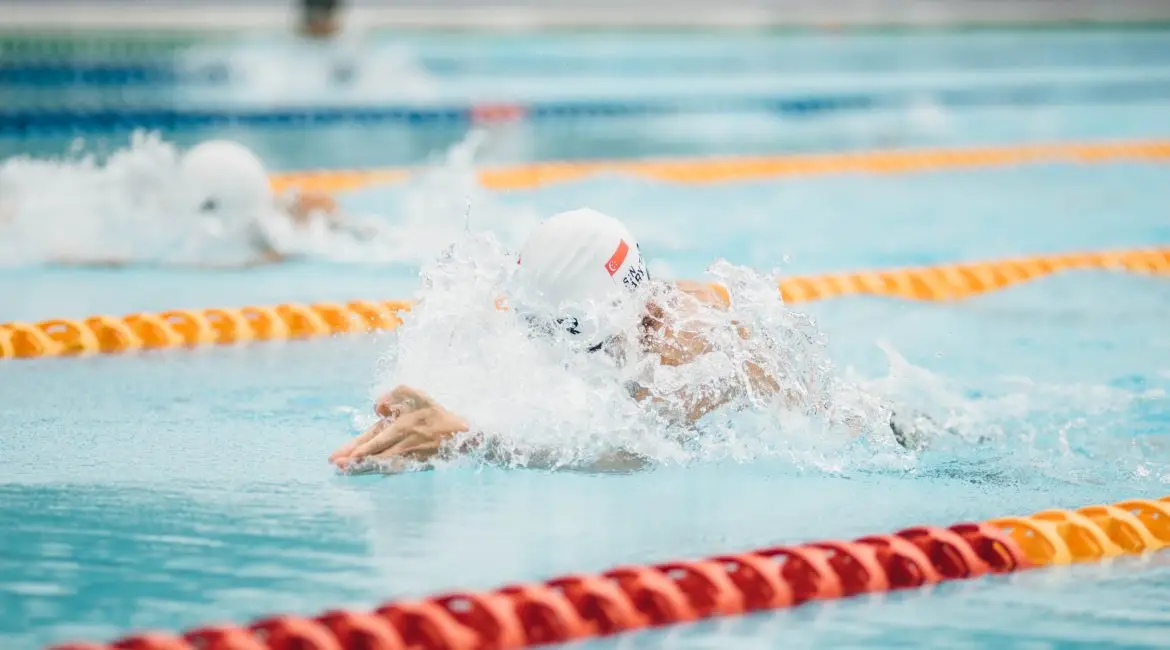
The classic Tabata is time-based, not distance-based, and that’s actually perfect for swimming. Instead of chasing a set number of yards, you simply swim as far as you can in each 20-second window. Freestyle, full send.
Here’s how to set it up:
- Warm up properly. Never dive into max sprints cold. Give yourself 400-600 yards of easy swimming, drills, and a few build-ups to prime your muscles. This isn’t optional — it’s your insurance against a tweaked shoulder.
- Use the pace clock or a watch. You need precise 20/10 timing. Most swim watches have interval timers, or you can post up at the wall with the pace clock. Push off the instant that 10 seconds ends — no lingering.
- Go truly all-out. Tabata only works at RPE 10. This is not “kind of fast.” It’s empty-the-tank, nothing-in-reserve effort on every single rep.
- Protect your form. Fast turnover, clean breakouts off the wall, strong finishes into the touch. Speed with sloppy technique just teaches your body bad habits.
- Don’t overdo the volume. One or two Tabata blocks per session is plenty. This is quality work, not a grind-fest.
What to Track (This Is Where the Magic Happens)
Because Tabata is time-based, it gives you a built-in performance metric: how far you traveled in each 20-second effort.
Count your distance on every rep and log it. This is the number that keeps you coming back. As your anaerobic power builds over the weeks, you’ll cover more water in that same 20-second window — an extra half-length here, a full length there. Watching that distance creep up is one of the most satisfying signs of progress you’ll ever track.
If you swim with a watch or app that logs your data, even better. Compare your average distance across Block 1 versus Block 2. Can you hold your output under fatigue? That’s the skill that pays off in races.
A Sample Pool Tabata Block
Here’s a session I come back to again and again. It clocks in around 1,700 yards and fits neatly into a single pool session.
Warm-Up (350 yards)
- 200 easy swim, choice, 30-second rest
- 100 kick with board and fins, moderate, 30-second rest
- 4 x 25 as fingertip drag/swim, 20-second rest – wear fins
Drill Set (150 yards)
- 6 x 25 as 3 drill / 3 build, 15-second rest — sharpen your catch and turnover
Main Set (800 yards) — two Tabata blocks
Block 1 (freestyle):
- 8 rounds of :20 max sprint / :10 rest (swim as far as you can in 20 seconds)
- 100 easy recovery after the block, 45-second rest
Block 2 (freestyle):
- 8 rounds of :20 max sprint / :10 rest
- 100 easy recovery after the block
Count your distance on every 20-second effort and write it down.
Cool-Down (250 yards)
- 100 backstroke easy, 30-second rest
- 100 freestyle easy, 30-second rest
- 50 choice, very relaxed
That easy 100 between blocks? Non-negotiable. It’s tempting to shortchange it when you’re gassed, but it’s the reason Block 2 stays sharp instead of turning into a survival crawl. Swim it genuinely easy, let your heart rate drift down, and you’ll protect the quality of the whole set. Always quality over survival.
How to Fit It Into Your Training Plan Safely
Tabata is potent, so treat it with respect. A few ground rules I live by:
- Keep it to once a week (or once every other week). For most triathletes, one dedicated Tabata swim session is plenty during a build phase. Any more and you’re flirting with overtraining.
- Place it on a fresh day. Don’t stack it on top of a brutal bike or run session. You want your body ready to deliver true max efforts, not scraping the bottom of the tank.
- Respect recovery. These sessions are demanding on your central nervous system, not just your muscles. Give yourself easy swims or full rest afterward.
- Listen to your shoulders. Sprinting stresses the shoulder joint. If you feel a niggle, back off. No single session is worth an injury that sidelines you for weeks.
- Build in gradually. New to sprint work? Start with one block, nail your form, and add the second block once you’re comfortable.
Ready to Get After It?
Tabata is proof that you don’t need endless hours to get faster — you need the right stimulus, delivered with intent. Four minutes of honest, all-out work will do more for your closing speed than a lazy 40-minute cruise ever could.
So next time you’re eyeing the pool clock, give it a shot. Warm up well, swim those 20-second efforts like the timing mat is right in front of you, and log your distances. Then come back next week and beat them.
Your fastest swim leg is built in these brutal, brilliant little four-minute chunks. Go earn it — and let me know how many lengths you covered.