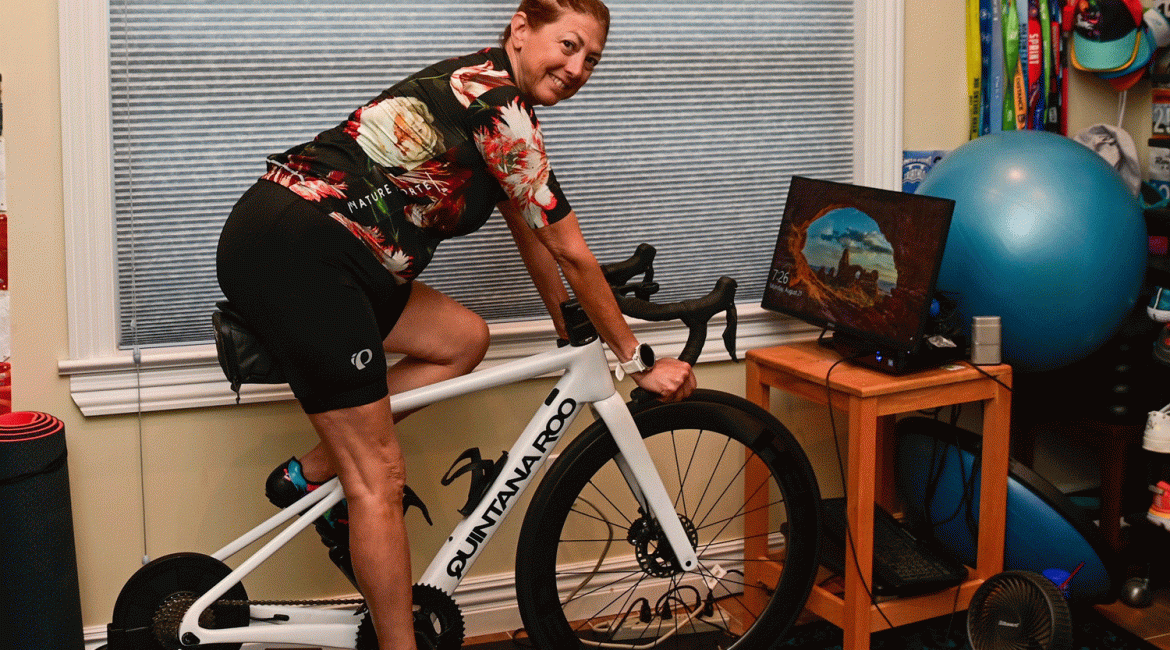
There’s a specific kind of suffering that comes with a cycling time trial. It’s not the slow burn of a long endurance ride or the sharp sting of a sprint. It’s something in between — a sustained, relentless push that asks you to hold on just a little longer than feels reasonable. I did one on Zwift recently, and I came out the other side dripping, gasping, and honestly — thrilled.
Here’s what happened, and why you should probably be doing time trials too.
What Is a Cycling Time Trial, Exactly?
Before I get into the sweat-soaked details, let’s talk about what a time trial actually is — because it’s more than just “riding hard.”
A time trial (often called a TT) is a structured benchmark effort. The idea is simple: you ride as hard as you can sustainably for a set duration. No drafting, no coasting, no shortcuts. Just you, your legs, and the clock.
In training, time trials are most commonly done as 20-minute efforts, which is why you’ll hear coaches and athletes talk about a “20-minute FTP test.” FTP stands for Functional Threshold Power — essentially the highest average power output you can maintain for about an hour. The 20-minute test gives you a solid estimate of that number, and from there, your training zones get recalibrated accordingly.
Think of it as a fitness snapshot. A hard, uncomfortable, very sweaty snapshot.
Why You Should Do One Every Couple of Months
Most cyclists spend a lot of time training. Fewer take the time to actually measure whether that training is working.
That’s where the time trial earns its place in your calendar. Here’s why doing one every couple of months matters:
- Track real progress. Without a consistent benchmark, improvement is just a feeling. A time trial gives you an actual number to compare against.
- Recalibrate your training zones. As your fitness changes, so should your zones. If your FTP goes up, training at the same old power levels means you’re undertraining. A time trial keeps everything calibrated.
- Assess gains in power and endurance. You might feel fitter, but how much fitter? A time trial answers that question with data rather than guesswork.
- Stay motivated. Seeing measurable improvement — even a modest one — is one of the most powerful forms of motivation in endurance sports. It validates the work.
Doing a time trial every 6 to 8 weeks is a reasonable cadence for most cyclists. Often enough to track meaningful change, not so often that it becomes a dread on the calendar.
The Warm-Up: Calm Before the Storm
My session started easily. A 10 to 15 minute warm-up, nothing too aggressive — just enough to get the legs turning, the heart rate climbing gradually, and the body reminded of what it’s about to do.
This part felt manageable. Almost pleasant. I spun through the virtual roads of Zwift, settled into my saddle position, and tried not to think too much about what was coming.
If you’ve never used Zwift, it’s a cycling platform that puts you inside an immersive virtual world where your real-world effort translates directly to on-screen movement. The visual feedback makes it easier to stay engaged, and the structured workout mode keeps you accountable to the numbers. For testing purposes, it’s genuinely excellent — it strips away the excuses and shows you exactly where you are.
The warm-up ended. The clock reset. And then the real work began.
20 Minutes as Hard as I Could Go
I’ll be honest with you: the first few minutes felt almost fine. I found my pace, settled into the effort, and thought — maybe this won’t be so bad.
By minute six, I had abandoned that thought entirely.
A 20-minute all-out effort is long. Long enough that you can’t just grit your teeth and survive — you have to pace yourself, manage your output, and fight the mental pull to back off every time your legs start to burn. And they will burn. Early, loudly, and persistently.
I was counting every minute. Not in a defeated way, but in the way you count when you know the only way through is forward. Twelve minutes left. Ten minutes left. Eight.
Sweat was dripping off my nose. My heart rate was high and climbing. Zwift showed my power numbers in real time, and I kept pushing to hold them, chasing the screen because it gave me something tangible to fight for.
That’s what the platform does well. It doesn’t let you get lost in your own head. The numbers are right there, the virtual road keeps moving, and somehow that makes the suffering feel more purposeful.
By the final two minutes, I was deep in that uncomfortable place where you’re not sure if you have anything left — and then you realize you do, because you have no choice. I pushed. I held on. And then it was done.The Result: 20 Watts
I sat up, caught my breath, and looked at the screen.
Twenty watts. That’s how much my power output had improved since my last test.
Twenty watts doesn’t sound dramatic if you’re not a cyclist. But if you are, you know what it means. It means the training is working. It means the hours of effort — the long rides, the intervals, the days when motivation was low and you went anyway — they added up to something real and measurable.
That number represents adaptation. Progress. A body getting stronger and more efficient at something it wasn’t built to do easily.
I was a dripping mess. My legs were spent. And I was genuinely thrilled.
Here’s to Getting Better
The time trial is one of the most honest tools in cycling training. It doesn’t flatter you, it doesn’t lie, and it doesn’t let you hide. But when the numbers move in the right direction, the feeling is hard to match.
If you haven’t done a structured time trial recently, consider adding one to your training plan in the next few weeks. Get a baseline. Put in the work. Test again in two months. Let the data tell you the story your training has been writing.
Twenty watts better than I was. And next time, I’m coming for more.