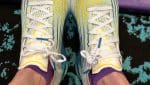

Every runner and triathlete dealing with plantar fasciitis eventually lands on the same advice: get a better shoe. Firm heel counter, stiff sole, real arch support. That advice is sound, and for some people it is enough. But look closely at most plantar fasciitis shoe recommendations, and you will notice a recurring caveat: many of the shoes worth buying are praised for having room to add your own arch support on top. For many athletes putting in real weekly volume, the shoe does only part of the job, and the rest depends on what you put inside it.
Signs Your Shoes Alone Aren’t Enough
Not everyone with plantar fasciitis needs more than a good shoe, but a few patterns are worth paying attention to: your pain has not budged after several weeks of consistently training in a supportive, well-reviewed shoe; your arches are noticeably higher or lower than average, putting you outside the neutral design most shoes are built around; you notice uneven wear on the outer or inner edge of your outsoles, which usually points to a pronation pattern the shoe’s built-in support is not fully accounting for; the pain has started showing up in your knees, hips, or lower back in addition to your feet, which often means an alignment issue is involved, not just cushioning; or you have already tried a generic, off-the-shelf insole and it did not change much.
Any one of these on its own is not a red flag. A few together usually mean the shoe has done what it can, and the arch support inside is the next thing to look at. Good Feet backs its arch supports with a 90-Day Customer Satisfaction Guarantee, which makes it a relatively low-risk thing to test during a training block.
Why the Fit of the Shoe Isn’t the Same as the Fit of Your Foot
Even a well-reviewed supportive shoe is a compromise. It has to accommodate a wide range of foot shapes, arch heights, and gaits within a single mold, which means the arch support built into the shoe is a generalized approximation rather than something matched to your foot specifically. That is exactly why so many podiatrist-recommended running shoes include a removable factory insole and extra interior volume, leaving room for personal arch support rather than assuming the shoe’s built-in support will be enough on its own. The shoe sets the foundation. Arch support closes the gap between a generalized fit and your actual foot.
Not all arch support products are built the same way, though, and the differences matter more than they might seem. Here is what to actually look for.
What to Look For in an Arch Support Solution
The fitting process.
The biggest variable between arch support options is whether the product is sized or fitted. A sized product comes in small, medium, and large, built around an average foot, the same limitation as the shoe itself. A fitted product starts with an actual assessment of your foot shape, arch height, and gait before you get anything. Good Feet Arch Supports use the fitted model: every visit starts with a free, in-store assessment from a trained Arch Support Specialist, who evaluates your foot shape, typically through some kind of scan or impression, and asks about your daily activities and where the pain shows up, whether that is your feet, knees, hips, or lower back. The support is then matched to your foot rather than assigned by shoe size, which is the same gap a sized insole cannot close no matter how good the underlying shoe is.
A range that covers different jobs.
Foot pain does not stay static, and neither should the support addressing it. A single insert meant to handle every stage, from acute pain to maintenance to recovery, is asking one product to do a job that often calls for a range. Good Feet’s supports are built around a three-step system: Strengtheners, Maintainers, and Relaxers. Strengtheners are the most structured of the three, designed to help reposition the foot into better alignment, and they are meant for everyday wear rather than running or other high-impact activity. Maintainers are the lower-profile option built to help hold that alignment during activity, and they are the appropriate choice for running and training shoes. Relaxers are the gentlest option, meant for rest and recovery rather than all-day wear, closer in spirit to the recovery-shoe category. Support needs change by activity and by shoe, and the product should adapt with them.
The guarantee.
What happens if the fit is wrong says a lot about how confident a company actually is in its product. A generic return policy that only covers unopened, unused items does not account for something like an arch support, which cannot be fairly evaluated until it has been worn for a while, often several weeks, as the foot adjusts. Good Feet’s 90-Day Customer Satisfaction Guarantee and an Arch Support Specialist stay involved through adjustments and check-ins as the fit is dialed in. If the fit still isn’t right after that process, you can return the arch supports within 90 days for a refund to the original payment method, with no restocking fees. That is a meaningfully different model than a standard 30-day, unworn-only return window that assumes you should know within a month whether an orthopedic product is working.

How to Combine Shoes and Arch Support
None of this means starting over on footwear. Structured running shoes with a removable insole were built to accommodate a personal arch support underneath, so pairing a well-reviewed plantar fasciitis shoe with a properly fitted arch support is not overkill. It is the combination those shoe recommendations were already built around. The shoe handles cushioning, heel stability, and overall structure. The arch support handles what varies from person to person: your actual foot shape and how much correction it needs.
In practice, that pairing tends to follow the shoe category. A structured running shoe has the volume and lacing to accommodate a firmer support during training. A casual or work shoe leaves less room, so a lower-profile support tends to fit better without crowding the toe box. A recovery shoe or sandal calls for the gentlest option, since the goal there is rest rather than correction. Matching the arch support to the shoe, rather than using one support across every pair, is part of what makes the combination work.
FAQ
Can I use a fitted arch support with any shoe?
Mostly, though thickness matters. A structured arch support needs a shoe with enough interior volume and, ideally, a removable factory insole to make room. Low-profile dress shoes and some sandals may only accommodate a thinner option.
How is a personalized arch support different from an over-the-counter insole?
An over-the-counter insole is sized, not fitted. It is built around an average foot and sold by general shoe size. A personalized arch support, like Good Feet’s, starts with an assessment of your specific foot shape and gait before you get anything, and the resulting support matches that assessment rather than a size chart.
I already tried a generic insole, and it didn’t help. Will a fitted option be any different?
It is solving a different problem than a generic insole was built to solve. Off-the-shelf insoles add general cushioning to an average foot shape. A fitted arch support matches your specific foot, which is often the variable a generic insole cannot account for.
What if the fit still isn’t right after I try it?
Good Feet’s 90-Day Customer Satisfaction Guarantee covers this. Your Arch Support Specialist works with you through adjustments and follow-up fittings first, and if it still is not working after that, you can return the arch supports within 90 days for a refund to your original payment method, with no restocking fees.
The Bottom Line
If supportive shoes have not resolved your plantar fasciitis pain, a fitted arch support solution, evaluated against how it is fitted, whether it adjusts as your needs change, and what happens if it does not work, is a reasonable next step to look into. None of this replaces a diagnosis. If pain is severe, has lasted more than a few weeks, or is getting worse despite changes to footwear and support, it is worth seeing a podiatrist rather than continuing to try products on your own.
This is a guest post contributed by an external author. The views and opinions expressed are those of the author and do not necessarily reflect the official views, opinions, or positions of the blog owner.